
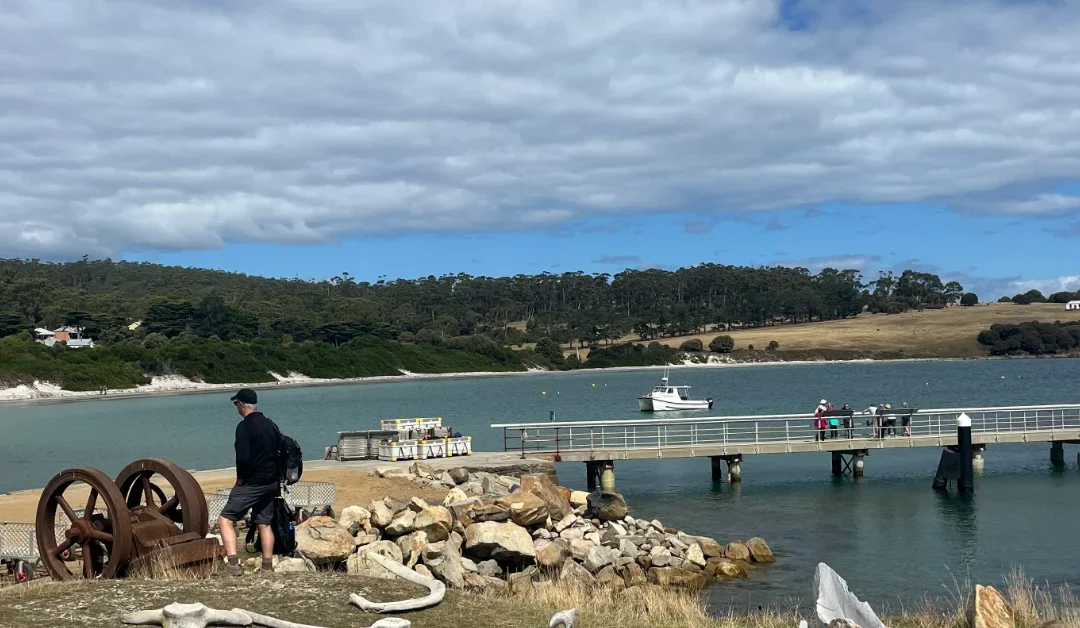
Key takeaways
- Maria Island is car-free, so wombats, geese and kangaroos graze unbothered and are easy to watch on foot or by bike.
- The island shelters roughly 70 to 80 Tasmanian devils and around 400 breeding pairs of the endangered forty-spotted pardalote, about half the species.
- Dawn and dusk around the Darlington grasslands offer the best, most respectful wildlife viewing.
- A 45-minute ferry from Triabunna is the only way across, which keeps the island quiet and wildlife calm.
- A private small-group visit adds context, keeps a safe distance and works as a full day or an unhurried overnight.
On Maria Island you can watch a wombat graze a few metres away while Cape Barren geese pick across the grass behind it. This car-free national park off Tasmania's east coast is one of the easiest places in the country to see native animals in the open, because nothing here is in a hurry and nothing is dodging traffic.
The island has earned the nickname "Noah's Ark" for rare animals and birds, and it lives up to it. Wombats, forester kangaroos, Bennett's wallabies, pademelons and Tasmanian native hens share the grasslands around the old convict settlement at Darlington. Overhead and in the bush you will find a remarkable concentration of birdlife. If you came for Maria Island wildlife and little else, you would still go home happy.
Which animals you are likely to meet
The star attraction is the wombat. Bare-nosed wombats are common across the open grass near Darlington, and because they have no predators and no cars to fear, they graze calmly in daylight far more than wombats usually do. Seeing one up close is close to guaranteed on a half-decent day.
Cape Barren geese are the other animal you cannot miss. These large grey geese, with their lime-green bill patch, were established on the island decades ago and now stride about the settlement flats as if they own them. They do, more or less.
Beyond those two, keep an eye out for:
- Forester kangaroos (the eastern grey), introduced in the 1960s and now grazing the grasslands in mobs
- Bennett's wallabies and smaller pademelons, more active toward dusk
- Tasmanian native hens, flightless birds that dash across the grass on foot
- Eastern quolls, which are nocturnal and much harder to spot
- Tasmanian devils, also nocturnal, so a daytime sighting is a rare bit of luck
The devils are worth a special mention. A conservation insurance population was established on the island, with 15 Tasmanian devils introduced in 2012, according to the Tasmania Parks and Wildlife Service. That founding group has grown into a managed population of roughly 70 to 80 animals. The island acts as a disease-free refuge from the facial tumour disease that has devastated devils on the Tasmanian mainland.
Birders have the richest time of all. Maria Island is home to about 125 bird species, and every one of Tasmania's endemic birds can be found here. The headline bird is the endangered forty-spotted pardalote, a tiny olive-green bird that depends on white gum woodland. Maria Island holds an estimated 400 breeding pairs, which is around half of the entire species, as reported by Australian Geographic. For a bird clinging on against extinction, that makes this small island one of its most important strongholds on earth.
Why Maria Island is a car-free wildlife sanctuary

There is no vehicle access to Maria Island. You explore on foot or by bike, and that single rule shapes everything about the place. Without the noise, speed and danger of traffic, animals stay relaxed and visible, and they tolerate people far closer than they would on a busy roadside.
That calm is also a safety net for the rarest residents. The island sits apart from the mainland, which has let it serve as a refuge: a Tasmanian devil population free of the facial tumour disease, and woodland quiet enough for the forty-spotted pardalote to breed in numbers. Isolation that would be a problem for a town is exactly what these animals need.
The catch, if you can call it that, is access. The only way across is a ferry between Triabunna and Darlington, which takes around 45 minutes. There is no bridge and no shuttle. The crossing filters out casual day-trippers and keeps visitor numbers gentle, which is part of why the wildlife watching stays so good.
Best spots and times for respectful wildlife watching
The grasslands around the historic Darlington settlement are the obvious starting point, and often all you need. Wombats, geese, native hens and kangaroos all feed in this open country, and you can cover a lot of it slowly on foot.
Timing matters more than location. Early morning and late afternoon are when the grazing animals are most active and the light is softest. In the heat of the middle of the day, many animals rest in shade and the grasslands can look surprisingly empty. Plan your walking around the edges of the day and you will see far more.
A few simple habits keep the watching respectful and keep the animals wild:
- Keep your distance and let animals set the pace. If an animal changes what it is doing because of you, you are too close.
- Never feed wildlife. Human food harms these animals and teaches them to approach people, which rarely ends well for them.
- Move slowly and quietly, and crouch rather than loom when you stop to watch.
- Stay on tracks where they exist, especially in the woodland the pardalotes depend on.
For keen birders, the white gum woodland is the place to listen for the forty-spotted pardalote's thin, insistent call. Seeing one takes patience, but knowing you are standing in the middle of half the world's population gives the search a certain weight.
How a guided small-group visit adds context and care

You can absolutely wander Maria Island on your own. What a guide adds is the layer you cannot see: which gum trees the pardalotes favour, why the geese are here at all, how the devil population is managed, and where the wombats tend to graze at that hour on that day. The animals become a story rather than a series of nice photos.
This is where Adventure Trails Tasmania fits. As a small, private and fully customised operator, we run the island at your pace, not a timetable's. A small group means less noise and less disturbance, which is better for the wildlife and better for you: closer, calmer sightings, and the freedom to linger when a wombat wanders into view rather than being herded along. Tasmania your way, built around what you most want to see.
A good guide also keeps the care front of mind. Knowing the right distance to hold, which areas are sensitive, and how to read an animal's behaviour is the difference between watching wildlife and disturbing it. That knowledge protects the animals and makes your own sightings last longer.
Planning a full day or an unhurried overnight adventure
Maria Island rewards a full day. Catch an early ferry, spend the cool morning hours among the Darlington grasslands while the wombats and geese are active, walk out to the painted sandstone cliffs or the fossil cliffs through the middle of the day, then let the late afternoon bring the animals back out before the return crossing. It is an easy, satisfying day on foot or by bike.
An overnight stay turns the volume up. With the day visitors gone, dawn and dusk belong to you and the wildlife. These are the quiet, golden hours when the island feels most like a sanctuary, and when the chance of a nocturnal animal crossing your path is at its highest. Adventure Trails Tasmania offers both single-day visits and overnight options, so the island can be a relaxed day out or the unhurried heart of a longer Tasmanian trip.
Maria Island also pairs naturally with the rest of the east coast. Many travellers fold it into a longer, fully customised east coast road trip with us, taking in Freycinet and more along the way.
The concrete next step is simple: pick your season, (out of peak season), and your pace, then book a Triabunna ferry crossing for early in the day. Get there with the morning still cool, walk slowly, and let Maria Island's wildlife come to you.
Frequently asked questions
Are there really wombats on Maria Island?
Yes. Bare-nosed wombats are common across the grasslands near Darlington, especially around dawn and dusk, and they are one of the easiest wild wombats to see in Tasmania.
Can you drive a car on Maria Island?
No. Maria Island has no public vehicle access. You reach it by ferry from Triabunna and explore on foot or by bike, which is a big reason the wildlife is so relaxed.
What is the best time to see animals on Maria Island?
Early morning and late afternoon are best. Wombats, geese and kangaroos feed in the open grasslands then, and the light is kinder for watching and photography.
Are there Tasmanian devils on Maria Island?
Yes. A conservation insurance population was established in 2012, and it is now managed at roughly 70 to 80 animals. Devils are nocturnal, so sightings in daylight are rare.
How do you get to Maria Island?
A ferry runs between Triabunna and Darlington and takes around 45 minutes. There is no bridge and no car access, so the crossing is part of the experience.